

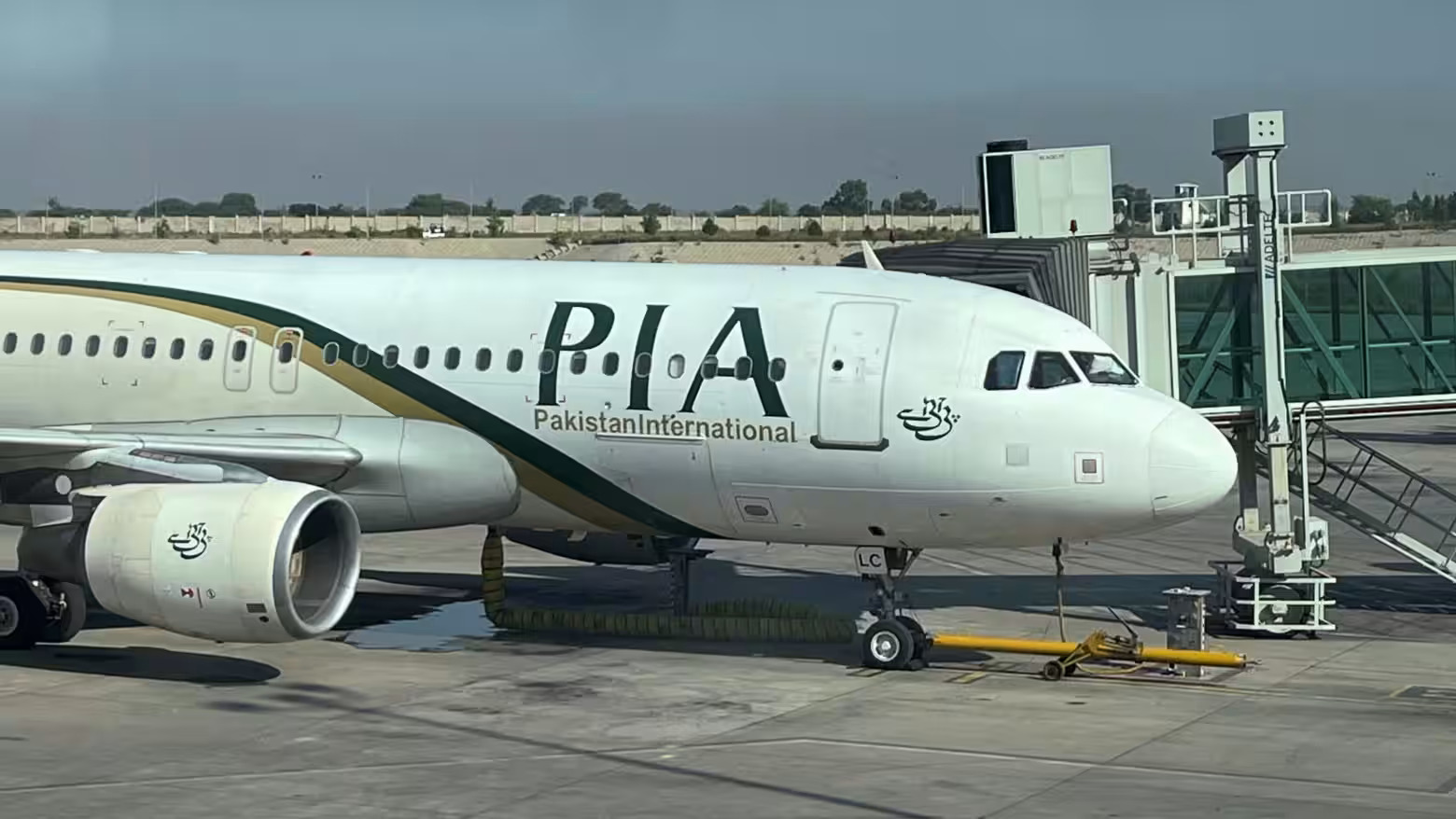
After a failed attempt last year, Pakistan International Airlines is scheduled to be taken private in a live bidding session on Dec. 23, with the government having improved conditions surrounding the sale. © Reuters
ISLAMABAD — Pakistan is inching closer to privatizing Pakistan International Airlines, the country’s national flag carrier, with the government setting the bidding for later this month. Experts say that the sale of PIA might help to clear the way for the divestment of other state-owned enterprises, but warn that the move will not be sufficient to fix the country’s ongoing economic weaknesses.
PIA is scheduled to be sold in a live bidding session set on Dec. 23, as Prime Minister Shehbaz Sharif announced during a cabinet meeting earlier this month. Four bidders, all Pakistani companies, have been pre-qualified to take part in the bidding, including Lucky Cement, stock broker Arif Habib Consortium, Fauji Fertilizer, and Airblue airline.
PIA currently operates a fleet of 17 active aircraft and employs over 6,500 people. In the financial year ended December 2024, it recorded revenue of $733 million and net profit of $94 million, achieving its first profit in 20 years, owing to a reduction in interest payments following the transfer of $2.4 billion in debt to its holding company. Currently, the airline has total assets of $672 million and total liabilities of $659 million.
In October last year, an attempt by the government to privatize PIA failed, as the only bid, for $36 million, fell short of the $305 million floor price.
Experts predict that the sale is highly likely to be successful this time.
“The government is offering a 75% share of PIA to the private buyer and has removed sales tax on aircraft imports, which makes the offer more attractive than past attempts,” Afsar Malik, an expert in airline management and a former director at the aviation authority, told Nikkei Asia. “These changes improve the chances that privatization may finally move forward,” he added.
But some question the nature of the bidders themselves. Talking to Nikkei, Ikram ul Haq, who runs a legal and tax consultancy in Lahore, made the point that fertilizer and cement manufacturers lack expertise in airline operations. “One wonders where is the transparency and consistency” in the selection process, he said.
PIA holds a share of about 30% in Pakistan’s domestic air travel market and about 16% in international routes. This makes it the second-largest carrier at home and the leading airline carrying Pakistanis abroad, according to Pakistan’s Civil Aviation Authority. Back in 2011, PIA controlled 78% of the domestic market and 43% of international traffic.
Experts said that PIA can be revived after a successful privatization.
Saleem Lalani, a senior finance professional who has worked in Pakistan, Singapore and the UAE, told Nikkei that a well-run national airline can competitively reclaim air traffic that has been captured by Gulf carriers offering direct flights to and from Pakistan.
Gulf airlines earn an estimated $500 million annually from Pakistan, according to IATA.
Lalani said that in the long run, PIA could also become a meaningful source of foreign-exchange earnings for Pakistan if privatization helps the airline seize some of the market share currently held by its rivals.
“For perspective on what is possible: Ethiopian Airlines generated $7.5 billion, IndiGo around $10 billion, and Emirates nearly $40 billion in revenue in 2025,” he told Nikkei.
Bilal Ghani, executive director of Gallup Pakistan, a survey research and consultancy firm in Pakistan, said that after privatization, PIA’s market share could grow in the domestic and international markets.
“I would, however, caution that talks of PIA becoming a large airline on international routes and competing with Emirates Airlines might not happen,” he told Nikkei.
PIA’s divestment will not be just a standalone case but a benchmark for Pakistan’s other divestment plans.
“PIA will successfully be sold this time around and it will set in motion privatization of two dozen SOEs, which will help be beneficial for the economy,” a government official dealing with economic matters, told Nikkei on condition of anonymity.
In October, the Pakistan government sold its stake in First Women Bank to Abu Dhabi’s investment firm International Holding Company for $14 million in a government-to-government deal. It was the first successful privatization case in Pakistan.
The bank and PIA are part of 24 SOEs that Pakistan plans to privatize by 2029. The others are electricity distribution and thermal generation companies, as well as those in banking, finance, insurance, minerals, engineering, and real estate.
Beyond the optimism from government officials, some experts are sounding a cautious note as the country struggles with a deepening economic crisis, even with IMF’s $7 billion in assistance. The latest budget shows a fiscal deficit of about $23 billion, which the state covers through borrowing. This pushed government’s external debt to nearly $92 billion.
The planned privatization of around two dozen state-owned enterprises, if all goes as anticipated, could raise around $5 billion, offering some relief to the government’s strained finances. But that alone cannot significantly reduce the government’s chronic reliance on debt finance.
Haq said that the dream of economic recovery through privatizing these enterprises is far-fetched. “Unless Pakistan implements fundamental structural reforms, there is little hope of achieving the goals set under the privatization framework,” he told Nikkei.